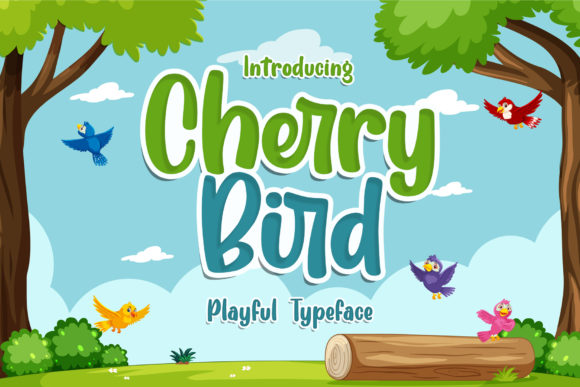
Cherry Bird Script Handwritten Font for Makers
It was 10 p.m., and I was tweaking the final label design for a small-batch lavender-vanilla candle—my best-selling scent—and realized something was missing. Not color, not layout, not even the illustration. It was *personality*. The serif font I’d been using felt polished but distant; the playful script I’d tried earlier looked charming but broke apart when scaled down to 12 mm on a 2-inch kraft sticker. That’s when I opened Cherry Bird—a bold and smooth handwritten font—and typed “Hand-poured • Small Batch • Made with Love.” Instantly, the label felt warm, intentional, and unmistakably *mine*. That’s the quiet magic of Cherry Bird: it doesn’t just sit on your design—it leans in and says hello.
Cherry Bird for Candle Labels and Handmade Product Packaging
Cherry Bird shines brightest where handmade authenticity matters most: labels, tags, and packaging that customers hold in their hands. As a Script Handwritten font, its bold weight holds up beautifully at 14–24 pt on matte sticker paper or kraft hang tags—even when printed on budget-friendly inkjet printers. I tested it on a 1.5-inch round sticker (for tea bag tags), a 3×4-inch candle box lid, and a linen gift tag—and every time, the smooth flow and consistent stroke width kept the text legible without sacrificing charm. Because Cherry Bird is PUA encoded, I accessed alternate lowercase ‘a’ and ‘g’ glyphs instantly in Canva and Silhouette Studio, swapping in softer versions for delicate product names like “Honey Lavender” while keeping bolder forms for “Small Batch” or “Hand-poured.” Just avoid using it for tiny ingredient lists or legal disclaimers—the decorative nature means it’s best reserved for display text, not dense information.
Cherry Bird for Wedding Invitations and Elegant Branding
When designing a suite of digital wedding invitations last spring, I needed a font that balanced playfulness with polish—something that felt personal but never childish. Cherry Bird delivered exactly that. Its smooth, connected letterforms create rhythm and elegance, while its subtle bounce and generous x-height keep it feeling joyful and approachable. Paired with a clean sans serif (I used Montserrat Light for body text), Cherry Bird became the star of the names, dates, and “Join Us” headers—never overwhelming, always memorable. As a Script Handwritten font, it also worked beautifully as a standalone element: I exported single-word SVGs (“Love,” “Forever,” “Celebrate”) for laser-cut wood signs and acrylic place cards. Bonus: because it’s PUA encoded, all swashes and ligatures appeared correctly across platforms—no missing glyphs in Etsy listing previews or PDF proofs.
Cherry Bird for Printable Wall Art and Digital Downloads
If you create printable wall art, planner pages, or quote-based digital downloads, Cherry Bird is one of those rare Fonts that feels both premium and effortless to use. I dropped it into a set of minimalist botanical-themed affirmations (“Breathe Deeply,” “You Are Enough,” “Grow Gently”) and watched how its bold yet fluid strokes anchored each composition—no extra shadow, no outline needed. Its readability at 36–60 pt makes it ideal for social media graphics, Pinterest pins, and mockup overlays, and because it’s PUA encoded, you can access stylistic alternates directly in Adobe Illustrator, Procreate, or even Google Docs (via the Fonts menu). For commercial use—like selling editable Canva templates or layered PSD files—just double-check the license covers digital resale (most reputable Script Handwritten fonts do, but always verify before listing).
Cherry Bird for Stickers, Tote Bags, and Merchandise Design
I ran a quick test: cut Cherry Bird at 1.25 inches wide on my Cricut Maker using vinyl, then heat-pressed it onto a natural cotton tote. Result? Crisp edges, no jagged joins, and zero issues with connecting strokes—thanks to its smooth, intentional hand-drawn flow. Unlike some overly ornate scripts, Cherry Bird avoids thin hairlines or dramatic entry/exit strokes that snag during weeding or peel poorly from transfer tape. It’s equally strong on mugs (sublimation-ready), enamel pins (clean vector conversion), and seasonal sticker sheets (think “Cozy Fall Vibes” or “Spring Blooms”). Pair it with a sturdy geometric sans serif for contrast—say, Poppins Bold for slogans or “Limited Edition” badges—and you’ve got instant visual hierarchy that reads clearly on mobile thumbnails and physical products alike.
Cherry Bird for Greeting Cards and Seasonal Craft Projects
Last holiday season, I designed a set of greeting cards featuring hand-lettered phrases like “Warmest Wishes,” “Joyful Moments,” and “Merry & Bright.” Cherry Bird gave them warmth without looking dated—and its playful feel meant they stood out next to more formal calligraphy or trendy minimalist fonts. As a Script Handwritten typeface, it performs especially well on textured cardstock: the bold weight prevents ink spread, and the smooth curves resist distortion during printing. For layered paper crafts or die-cut cards, I recommend using the lightest version of Cherry Bird (if available) or reducing opacity slightly for shadow layers—its consistency makes it forgiving for multi-layer builds. And yes—it’s absolutely suitable for short phrases, names, titles, and decorative accents. Just don’t force it into paragraphs or fine-print footers. Let Cherry Bird be the voice, not the whole conversation.