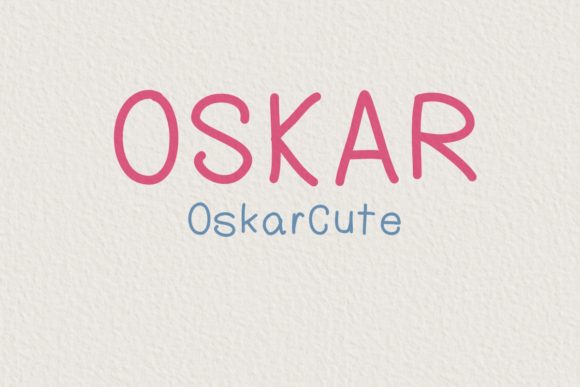
Oskar Script Handwritten Font for Makers
It started with a candle label—three small jars lined up on my work table, blank kraft stickers waiting, and that familiar “what font feels like *this*?” pause. I’d just restocked lavender-scented soy wax, tied twine around each lid, and knew the label had to whisper warmth—not shout. That’s when I opened Oskar, the Script Handwritten font I’d saved for moments like this. Within minutes, “Lavender & Light” flowed across the sticker mockup in soft, uneven strokes—no rigid spacing, no forced elegance. Just friendly, natural handwriting that looked like it belonged in my hands, not a design studio.
Oskar for Wedding Invitations and Elegant Branding
Oskar shines brightest where emotion meets intention—like wedding stationery that balances romance with approachability. I tested it on a suite: invitation, RSVP card, and welcome sign mockup. As a Script Handwritten font, Oskar doesn’t try to mimic calligraphy masters—it leans into gentle imperfection: slight variations in stroke weight, subtle entry/exit tails, and airy letter spacing that breathes without crowding. It’s friendly and cute, yes—but also quietly confident. On thick cotton paper, printed in muted sage ink, Oskar made “Emma & James” feel intimate, not twee. Paired with a clean sans serif (like Montserrat Light) for addresses and details, it created hierarchy without contrast fatigue. For Etsy sellers offering digital invitation templates, Oskar adds instant warmth to previews—and converts well because buyers *feel* the tone before they read a word.
Oskar for Printable Wall Art and Planner Pages
When designing printable wall art for a spring-themed planner bundle, I needed something that felt handmade but still legible at 8x10 inches. Oskar delivered—especially in larger sizes. As a Script Handwritten font, its charm lives in display use: titles like “Bloom With Intention” or “Gentle Beginnings” pop with personality. But here’s what matters for printables: it holds up crisply when scaled down to 14–16pt for section headers on weekly spreads. No blurring, no fragile loops collapsing. I exported as PNG and PDF—both rendered cleanly in Canva and Adobe Illustrator. Just remember: Oskar isn’t built for body text. Skip long paragraphs or fine-print disclaimers. Save it for quotes, titles, and decorative accents—the kind that make your digital download feel like a curated gift, not a generic template.
Oskar for Product Labels, Stickers, and Boutique Tags
This is where Oskar surprised me most. I cut a batch of 1.5-inch round stickers for herbal tea blends using my Cricut Maker—and worried the delicate ‘g’ and ‘y’ descenders might snag or tear. They didn’t. The Script Handwritten rhythm stayed intact, even at that scale. Same with kraft hang tags for handmade soaps: “Oat + Honey” in Oskar felt personal, tactile, and shop-ready. For physical production, test your cut settings first—Oskar’s moderate contrast and open counters help it register cleanly on vinyl, matte sticker paper, and uncoated cardstock. Bonus: it pairs beautifully with a simple serif (think Playfair Display) for ingredient lists or brand names—keeping your Fonts library lean while supporting both voice and function. Just avoid cramming more than 3–4 words on tiny labels; let Oskar breathe to stay legible and lovely.
Oskar for Tote Bags, Mugs, and Seasonal Merchandise
I screen-printed “Hello, Summer” onto a natural canvas tote using a heat-transfer sheet—and watched how Oskar softened the whole piece. Unlike bolder script fonts that can dominate fabric, this Script Handwritten typeface settles in gently. Its low x-height and rounded terminals keep it from feeling sharp or stiff on curved surfaces like mugs or curved wooden signs. For seasonal craft fairs, I used Oskar on holiday tags (“Joyfully Wrapped”), jar labels (“Spiced Cider Mix”), and even chalkboard-style digital mockups for Instagram listings. It reads as handmade, not mass-produced—exactly what shoppers scan for in saturated markets. Licensing note: double-check that your Fonts license covers commercial merchandise (it does for Oskar’s standard version), and always embed or outline before sending files to printers.
Oskar for Greeting Cards and Handmade Packaging Design
There’s a quiet magic in seeing Oskar on a folded greeting card—especially one you’re mailing to a friend. The Script Handwritten flow makes “Thinking of You” feel handwritten, even though it’s perfectly consistent across dozens of cards. I ran it through my home printer on 110lb linen cardstock, then added a gold foil accent to the “O” in “Oskar”—and suddenly, the font wasn’t just part of the design, it *was* the sentiment. For boutique packaging, Oskar works best on front-facing elements: belly bands, ribbon tags, box stamps. Avoid using it for dense legal text or barcode-adjacent info—it’s a display font, not a utility font. And if you're layering it digitally (for SVGs or layered Canva templates), know that Oskar includes basic OpenType features—ligatures for “fi” and “fl”, plus alternate lowercase ‘a’ and ‘g’—so your designs stay fresh, not repetitive.